PPW News

Building Reader Loyalty

By: Kim Krisco

Like most writers, I have honed my writing skills by reading countless books, attending workshops, and joining writer’s groups – all with one goal: to get published. Then it happened, a London publisher accepted one of my novels. It wasn’t long after I popped a celebratory champagne cork that I recognized that I now had a different goal – one I should have had from the start . . . writing stories that keep readers coming back for more. These two goals are similar, differing primarily regarding where to put your emphasis and attention as you write.

Three Attributes to Garner Reader Loyalty

I hoped that there was one book or workshop that addressed reader loyalty. And while I found that many offerings touched on reader loyalty, no single article, book, or workshop focused on this topic. However, pieced together some of the best advice and condensed it to three attributes that garner reader loyalty:

  • Enriching subplots,
  • characters that readers relate to and
  • employing highly relevant themes.

As we explore these you will likely discover that you currently employ some or all of these in your stories. Congratulations! Now . . . if you can infuse your stories with all three attributes consciously and intentionally, your storytelling will become even more masterful.

Enriching Subplots

A subplot is a side story that runs parallel to the main plot, and it often involves a secondary character who plays a minor role in the main story. Subplots not only add richness and nuance to your tale but become a device for sharing background about your main protagonist that might otherwise come off as clumsy and contrived if you did it within the main story. In the Harry Potter anthology, a ripe example is Harry’s aunt and uncle, who believe Harry’s powers are evil. They enrich the “good versus evil” battle that is the central theme and reveal important character traits in Harry that come into play later in the story.

My primary protagonist, Tessa Wiggins, has reoccurring subplots that follow her through my novels: crushing guilt for having abandoned her little sister in an orphan asylum, an on-again/off-again love affair with Clark Button, and an ever-present belief she is ‘never good enough.’ Each story also introduces a new, unique subplot. For example, in The Magnificent Madness of Tessa Wiggins, she struggles to find ways to repay the kindness of her childhood friend Sherlock Holmes. Of course, even the best subplot won’t be enough if you don’t have a protagonist that readers learn to love.

Characters With Which Readers Identify

One of the reasons we follow a particular author is that we become invested in one specific character – usually the primary protagonist. Think Mildred Wirt Benson’s Nancy Drew, or Conan Doyle’s Sherlock Holmes (the most popular fictional character of all time). People tend to follow characters rather than authors, so how do you write characters that readers will invest in?

The formula, while logical, is multifaceted. People identify with characters who are likeable, are in jeopardy, flawed, vulnerable, courageous, and (here’s a big one) get in touch with their own power. The first five attributes are familiar, but the last is often glossed over or simply chalked up to “agency.” But characters who are or get in touch with their own power is more significant.

To oversimply, the act of claiming personal power requires overcoming character defects such as crippling low self-esteem, overpowering ego, crushing fear(s), etc. While readers do not necessarily possess these character defects in the extreme, everyone is familiar with them to some degree because it shows up in negative self-talk. This internal battle within your protagonist is, in some ways, the actual conflict that takes place within a story. The proof that your hero has won this battle comes in the climax when they risk it all to achieve the goal motivating their actions from the start.

All these characteristics come together for me in my protagonist Tessa Wiggins, a turn of the twentieth-century Irish lass who grew up in the impoverished, crime-ridden borough of Spitalfields in London’s East Side. With that beginning, it is easy for me to create sympathy for Tessa, who struggles against all odds to become a hero with which everyone can identify.

The final attribute needed to gain reader loyalty, if mentioned at all, is usually done as an aside; but I believe it may be most important.

Highly Relevant Themes

Great authors had great themes that resonated with the times they wrote. Charles Dickens’ themes were the misery of the proletarian classes and the exploitation of child labor coming into the public’s consciousness during the industrial revolution. Jane Austen’s works revolved around the theme of self-improvement through courageous self-examination and education. Her novels were written when women were beginning to stand up to the patriarchy that had been smothering them for centuries.

Let me propose that relevant and timely themes woven within the core story are one of the primary things that engages and maintains loyal readers. Like the ones noted above, the themes were relevant in their time, but may or may not resonate with today’s readers. My chosen themes are gender equality (particularly women’s rights) and environmental sustainability. I hope we can agree that these are relevant today.

The wonderful thing is that consciously and intentionally employing relevant themes help shape your story in new and surprising ways. For example, my commitment to building my stories around women’s rights and environmental sustainability led me to research Celtic history because the Celts enjoyed a harmony between the roles and rights or men and women that is not based upon the superiority of one sex over another. In the world of the Celts, women were warriors, poets, and even Druids — the latter being more powerful than any monarch. While I might have written stories set in the time of the Celts, it was more impactful to bring the Celtic ethics and beliefs into a more modern era to draw a sharper contrast. I picked the post-WWI period because women’s suffrage was taking root then.

My last three novels: Irregular Lives, The Celtic Phoenix, and The Magnificent Madness of Tessa Wiggins, roll out chronologically as Tessa grows from a London street urchin into a powerful Celtic woman and Druid priestess. Within these three stories, readers are introduced to the Celtic ethos, and through magical realism, readers meet a diverse cadre of formidable women. Not all of them are good or perfect, but all are powerful in their own way. I hope that the next century will be one in which men and women no longer need to indulge in an unwholesome gender rivalry that has undermined all of us for centuries.

In conclusion, nothing offered here is meant to discount the importance of a great story or well-crafted prose, but rather point toward the kind of fiction that keeps readers coming back for more: enriching subplots, characters that readers relate to, and highly relevant themes. Keeping all those literary balls in the air is what makes writing so challenging and rewarding.


Kim Krisco

Kim Krisco is the author of four novels: Sherlock Holmes—The Golden YearsIrregular Lives: The Untold Story of Sherlock Holmes and the Baker Street Irregulars, and The Celtic Phoenix— published by MX Publishing in London.  His latest release, The Magnificent Madness of Tessa Wiggins, features a formidable 1920’s Irish lass from the London slums who strives to become a Druid priestess.

Prior to writing full-time, Kim served as a consultant, trainer, and coach for business and non-profit organizations and their leaders.  You can find out more about Kim and his books on his website.

He and his wife, Sararose Ferguson, live in the Rocky Mountains in tiny homes that they built themselves on the North Fork of the Purgatory River.  Kim likes to say that “living on the Purgatory River may not be heaven, but it’s a writer’s paradise.”

Off the Grid

Disconnecting to Stay Motivated & Ward off Procrastination

By: Jenny Kate

Did you know, Americans spend an average of 6.5 hours a day on the internet. Pew Research found that most of us spend almost a full day on the internet a week. That’s nuts!

Does the internet help you procrastinate? Does it distract you from writing? Do you ever get sick of being online?

For me, yes to all of the above.

Going to Costa Rica

A year ago, we had to cancel plans to Costa Rica because of COVID. This year, we finally went. And I’ve been thinking about the positive effects of being off the grid. Especially for writers.

I was off the grid, completely, for ten days. No phone. No tablet. No internet. In those ten days, I read five paper books. I slept. I meditated. I swam, surfed and hiked. I ate good food. Took some Spanish lessons on the beach. I wrote by hand.

But I was in Costa Rica.

Get off the Grid!

Back in the day, that would have mattered because we really were unreachable. These days, we’re completely reachable no matter where we are. I had to deliberately put myself off the grid.

So, could I do this at home?

We live our lives online. My day job is spent on the computer. And because I’m in marketing and communications, it’s also spent on social media and news sites. The other day, I was in two meetings – at the same time. One on Zoom and one on Microsoft Teams AND I was answering emails and watching my phone in case a text came in.

How ridiculous is that? Am I supposed to write after that? Um, no. After that, all I want is a stiff drink and some mindless television.

But I don’t have that kind of day on the weekend or holidays. So could I go off the grid in some sense, and rejuvenate without having to fly across the planet to do it?

An Experiment

A little experiment told me yes. But it’s not off the grid in the way living in the Alaskan bush is off the grid. It’s more like deliberate breaks from my devices.

My experiment lasted three weeks. Here’s what I did:

  • Logged off the internet by 5:30 every day during the week.
  • Left my phone to charge downstairs (not by my bed). Every night.
  • Left my tablet downstairs and read paper books instead of watching TV before I went to bed. Every night.
  • Turned off all notifications on my phone after 5:30pm and all weekend. (I did have an exception for my daughter and my husband. They have their own ringtones for calls and texts).
  • Wrote by hand on a yellow notepad. Then transferred that to my Atticus program during the week.
  • Continued my daily walk habit (this has been a gamechanger for me the past two years).

The Results

I felt less overwhelmed and less anxious. And way more productive in my writing over the weekend than I have in quite some time.

Will this work for you?

Maybe not this exact scenario, but think about your life and where you can experiment with being off the grid. Maybe it’s an internet blocker while you’re writing? Apps like Freedom, Cold Turkey, or AntiSocial are good ones to block internet distractions and let you focus on writing. Business Insider found Fortune 500 company execs were way more productive when they used these types of apps.

How about taking all social off your tablet and use it only to read your Kindle books? Leave the social for your phone and designate a time to scroll. Then stick with it.

Or put a reminder on your phone to get up and walk around every hour?

One of the reasons I think it was so easy in Costa Rica was because there was a lot to do other than being on my phone.

So what can you do that is motivating and fun offline?

Well, one thing is write. We’re writers. That’s what we do. The minute you feel the itch, ask yourself is there something you could be doing to advance your story instead? Create a story bible. Do a character sketch. Draw a map of your setting. Create a family tree. None of these have to be done online.

Another thing is live your life. It’s a little hard to write about life if we really aren’t living it anywhere but on a 4×5-inch computer in our hands. Become a tourist in your hometown. Visit museums, parks, other attractions you’ve saved for “one day” and haven’t gotten around to. Take up tennis or hiking or sailing. Whatever. Find a weird, fun, quirky habit you enjoy. My daughter paints. I cook. We both like to make soap.

Whatever you decide, let it feed your soul and keep you motivated.


Jenny Kate

Jenny Kate is the founder of Writer Nation, an online space dedicated to helping writers market their work. With 19 years communications experience, she regularly writes on social media, internet marketing and face-to-face publicity. You can find her on her WebsiteFacebook, and  Instagram


Could A Scene List Help You Write Better?

By: Kim Olgren

Whether you’re a pantser or a plotter, you need to know about scene lists. This is a tool that can change your life as a writer. Pantsers don’t run away. I promise I’m not trying to convert you I’m trying to help you. Don’t be afraid of the big, bad spreadsheet program.

What Is a Scene List?

A scene list can be as simple or as thorough as you want it to be. As a pantser, you might just make a simple list of scenes in a spreadsheet program like Excel or Google Docs just for quick reference as to where something happened. Especially if you’re writing in a program like Word where you looking at one, large, running document. I mean, scrolling through a 100k Word document to see where you first hinted at that smoking gun has to be one of the most tedious and unnecessary actions one can be bored to tears doing. On the flip side, plotters, you’re probably already thinking about tracking all those pesky little details floating around outside of your beautiful outline.

What Can a Scene List Do for You?

Your scene list can be so useful that it can assist you from the maze of the (gasp) outline and first draft, all the way through the bog of revisions, bypassing the junk fields altogether, and right up to publishing castle. A scene list can help with everything from character traits to timelines.

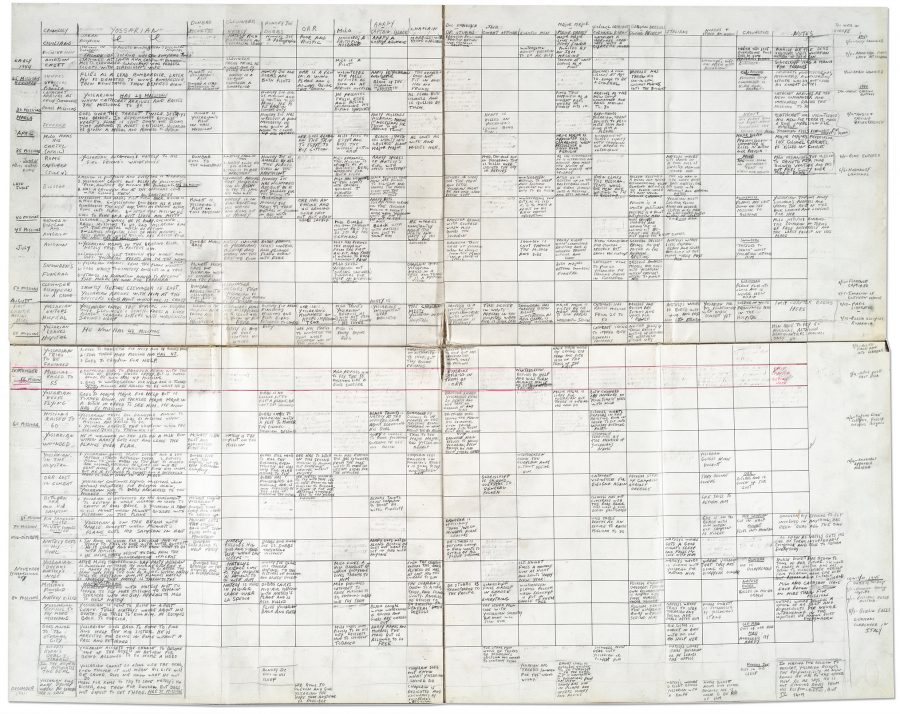
Here’s the hand-written scene list from Joseph Heller’s novel Catch-22.

Looks complicated? It’s not. Remember all these squares were filled in over a long period of time. As writers we all know this stuff takes time and odds are it’s not going to look the same as when you first started. However, a scene list can help keep you on track. Especially when you’re wandering around in the purgatory of the soggy middle. Your scene list can put you back on track and moving forward.

Finally, you’re down to the nitty-gritty. It’s time for editing. But wait! You know there’s some missing scenes and some that need to be sent to the abyss. But which ones? Never fear! Your handy scene list is here! Need to drop that meaningful backstory comment that foreshadows why Jane is so afraid to let anyone get close? Browse your scene list. You know you have to pull that scene where that one thing happens that, as it turns out, is totally irrelevant to the story? Browse your scene list. You can highlight what you want to keep or toss in different colors, or highlight POV so you can track how much page-time your characters are getting. The possibilities are endless.

Get the most from your scene list

Here’s some information you might want to include to get the most out of your scene list (you can do more or less, or do it completely differently, it’s all up to you):

  • Scene number
  • Chapter the scene is found in
  • Estimated word count
  • Actual word count
  • A short scene summary
  • POV
  • Other characters involved
  • The scene’s structure
  • Date the scene takes place within the story
  • The setting in which the scene takes place

You can use a spreadsheet, some kind of outline form in a word processing program, the cork board in Scrivener, sticky notes on a wall or in a folder, graphing paper, or some other helpful writing tool you prefer. Your scene list can be the map to your novel, showing you all corners of the world you’re building and everything within it at a glance. Your all-seeing eye gazing into your newly forming world.

May your pen be swift, prolific, and true!


Kim OlgrenK.A. Olgren has voraciously read anything she could get her hands on for as far back as she can remember. She’s always been a sucker for a good mystery in any form. By the time she’d entered elementary school she was writing her own stories and squirreling them away for her own eyes only. She’s worn many hats but writing has been her constant companion. When not wrestling with words or curled up with them (it’s a complicated love/hate relationship), she can be found flipping houses with her husband, volunteering within the local writing community, crocheting badly, traveling sporadically, or hanging out with her family and faithful German shepherd/lab mix in the beautiful Rocky Mountains of Colorado. Visit the author’s website.   

Sweet Success for Jenna MacFarlane

Congratulations to Jenna MacFarlane on the recent release of her first novel, HARDWARE STORIES. This mystery features an awkward female hardware store clerk and one horrific murder to solve.

Hardware Stories cover image

ABOUT THE BOOK: 

If you combine 44–year-old Claire Cunningham, an awkward female hardware store clerk, and a horrific problem to solve, the stage is set for HARDWARE STORIES. When the police accuse one of Claire’s co-workers of a brutal murder, she becomes an unlikely detective. Her curiosity places her in direct conflict with the establishment, exposing a scintillating underbelly and threatening to undermine her beloved city, Boleyn, North Carolina. She must decide whom to trust in a place where the practice of swift justice screams Wild West rather than gentile South. Striking out on her own to solve the crime while avoiding the advances of a stalker, she clashes with the law and everyone who matters. Purchase a copy through Amazon.

Jenna MacFarlane

ABOUT THE AUTHOR:

Jenna MacFarlane’s first novel, HARDWARE STORIES, debuted in February 2022. Her story “Old Debt” is published in the anthology About Time. MacFarlane holds a BA in Studio Art from Humboldt State University and has lived in the central Piedmont of North Carolina for many years. When MacFarlane’s not writing, hiking, painting, or restoring, she’s stocking shelves at a local supermarket. MacFarlane’s memoir, HINDSIGHT, will be published in 2023.


Darby Karchut

Sweet Success is coordinated by Darby Karchut who is an award-winning author, dreamer, and compulsive dawn greeter. A proud native of New Mexico, she now lives in the foothills of the Rocky Mountains, where she runs in blizzards and bikes in lightning storms. Click here to submit your Sweet Success Story.


Building Believable Characters

By: Donna Schlachter

As writers, we understand the importance of plot—the action of the story. Without it, nothing happens. With a bad plot, we’ll bore our readers, or confuse them, and they’ll do the unthinkable—toss our book aside and never buy another.

Along with plots go subplots, those extras to the main story that keep things rolling along when the main story is off the page. Important to have the exact right number—not one too many or too few. Keeps our characters busy with the other things going on in their lives, because face it—we all do more than one thing.

We might also spend a lot of time deciding on setting—real or fictional—as well as themes, foreshadowing, and more. Every genre has its expectations. For example, in a romance, the reader expects a reason why the love interests can’t or won’t get together. In a mystery, red herrings and suspects and motives are of interest. In fantasy, world-building is critical.

Develop Believable Characters

Sometimes we can be so focused on these other parts of the story structure that we neglect to develop believable characters, so when we start writing, we simply get going on the story.

But often what happens then is that our characters start to talk and act like stereotypes, which is not what we want. Sure, we don’t want them so weird that they’re unbelievable. Or so evil the reader can’t relate to them. Or so wishy-washy our audience hates them.

No, what we want are characters who are different, yet the same.

I know, that sounds contradictory. So let me give you an example.

In my first mystery series, penned under my alter ego of Leeann Betts, my main character was a forensic accountant. YAWN! Accountants. In fact, the first editor I approached with my series flat out told me “nobody wants to read about accountants. They’re boring.” Probably not her fault that I didn’t explain my story better.

My accountant is a woman. In her fifties. Always ten to fifteen pounds overweight, no matter how much she tries. Favorite outfit are sweatpants and a t-shirt. Dressing up involves jeans. Married for the second time. Step-kids she loves. Living in a small town for the first time in her life. For over ten years. Still feels like an outsider. Loves mysteries, and hates to leave one unsolved. In fact, the first one she ever got involved in, she was almost killed. Hence my prequel story, Roasted Bean Counter. As you can tell from the title, she tries not to take herself too seriously. She hates exercise and subscribes to the theory that each person is given a certain number of heartbeats to use before they die. Once they’re gone, you’re gone. So she’s not going to shorten her life by increasing her heart rate simply so she can sweat. She also jumps to conclusions, or so her husband says. Not to mention that she hates change. Her motto is: I can be as spontaneous as anybody if I’m given enough time. Oh, and she tries not to take anybody else too seriously, either. Her sassy mouth and quick comebacks have often gotten her into trouble.

Did you notice something about my description? Not once did I mention the color of her hair, her height, her eyes, if she has a dimple or a mole on her cheek. Nothing about her apart from her age and her slight weight problem. Yet I bet you saw her in your mind as I was describing her.

Avoid the Traps

One trap writers often fall into is describing their character as though they’re reading off their driver’s license. Sure, we might disguise it a little: Her blue eyes contrasted nicely with her dark, shoulder-length, wavy hair, and at five ten and a hundred and twenty pounds, she was svelte but not scrawny.

If her physical description isn’t important to the story, we don’t need to know. So, for example, if her blue eyes made her the only kid in her family that didn’t have brown eyes, and her parents are both brown-eyed, this might make her wonder if she was adopted. Or illegitimate.

Dichotomies in physical build from her siblings or others in her family might also cause her to question her lineage. Being tall and slender might allow her to hide in a narrow space, which could be helpful if she was being chased by the bad guy. But bring that out early in the story—don’t just spring it on the reader when she needs to hide.

What does your character know?

In my mystery series, my character’s understanding of accounting, banking, and the court system are often used to help her solve the crime. In addition, because she needs to hold an expert status in forensic accounting, she must always act with honesty and integrity. Poor credit rating and issues such as overdrawing her bank account will figure negatively in that regard. I use both the question of integrity and of fiscal responsibility in two of the books to create tension between her and the crime.

I mentioned she loves her step-kids, so you can expect her to respond like a Mama bear when her kids are threatened in any way. Several books in the series center around family and the need to clear them of suspicion in various crimes.

Once you create a character sketch for your story, you must strive to ensure that every decision either goes along with who that character is, or you’d better have a good reason for it not to be. Unbelievable characters are those who act contrary to the information you’ve already told the reader. While you can put your character in a position to be forced to choose between two bad outcomes, there must be something the reader already knows about the character so the choice isn’t unbelievable.

Next month, we’ll talk about creating a strong secondary character to complement and challenge your main character.


Donna Schlachter

A hybrid author, Donna Schlachter writes squeaky clean historical and contemporary suspense. She has been published 50+ times in books under her name and that of her alter ego, Leeann Betts; is a member of several writers groups; facilitates a critique group; teaches writing classes; ghostwrites; edits; and judges in writing contests. She loves history and research, traveling extensively for both.

She lives in Denver with her husband and two cats, finding mysteries wherever she travels. You can find her books on Amazon under both her name and that of her former pen name, Leeann Betts. Follow Donna on her website, blog, Goodreads, Bookbub, Twitter, and Facebook.

Sweet Success for Kelley Lindberg

By: Darby Karchut

Yay for this happy news! Kelley J. P. Lindberg is pleased to announce that she is now represented by Lynnette Novak at The Seymour Agency. Her YA novel, TRUE LOVE NEVER, is an award-winning contemporary Shakespeare retelling with magical realism.

Kelley Lindberg

ABOUT THE AUTHOR:

Kelley J. P. Lindberg writes award-winning YA and adult fiction, and sometimes admits to having penned several best-selling how-to books in her early career. When she isn’t writing or reading, she’s traveling as far and as often as she can. Kelley has spoken at numerous writing conferences and workshops. Her fiction and essays have appeared in The Baltimore Review, The Citron Review, 99 Pine Street, CHICKEN SOUP FOR THE WINE LOVER’S SOUL, and others, and in the Tellables app for the Amazon Alexa platform. Visit Kelley’s website at www.KelleyLindberg.com, and be sure to follow her on Facebook, Twitter, and Instagram.


Darby KarchutSweet Success is coordinated by Darby Karchut who is an award-winning author, dreamer, and compulsive dawn greeter. A proud native of New Mexico, she now lives in the foothills of the Rocky Mountains, where she runs in blizzards and bikes in lightning storms. Click here to submit your Sweet Success Story.

Sweet Success for Fleur Bradley

By: Darby Karchut

Three cheers for Fleur Bradley! Her new 6-book creative non-fiction series for the educational market, aimed at reluctant readers, entitled How the World Worships recently released from 45th Parallel Press (imprint of Cherry Creek Press). Visit the publisher’s website for more information.

ABOUT THE BOOKS

Readers will learn about the core teachings and beliefs of the world’s most widely practiced religions through the lens of two different perspectives, one from the United States and the other from another country where the religion is predominant, and dive deep into the important figures, sacred texts, holidays, and commandments. This narrative nonfiction series uses considerate text that is written at a higher maturity level with a lower reading level to engage and accommodate struggling readers. Includes sidebars that are aligned with the Common Core Standards, a comprehensive timeline, and activity. A table of contents, glossary with simplified definitions and pronunciations, and index are also included.

Fleur Bradley

ABOUT THE AUTHOR

Middle-grade author Fleur Bradley is passionate about two things: mysteries and getting kids to read, and she regularly speaks at librarian and educator conferences on reaching reluctant readers. Originally from the Netherlands, Fleur now lives in Colorado Springs with her family, and entirely too many rescue animals. Be sure to visit Fleur at ftbradley.com and follow her on Twitter.


Darby Karchut

Sweet Success is coordinated by Darby Karchut who is an award-winning author, dreamer, and compulsive dawn greeter. A proud native of New Mexico, she now lives in the foothills of the Rocky Mountains, where she runs in blizzards and bikes in lightning storms. Click here to submit your Sweet Success Story.

Sweet Success for J.D.R. Hawkins

By: Darby Karchut

Congratulations to J.D.R. Hawkins! She recently participated in the anthology, SUCCESS MINDSETS, from Leaders Press and edited by Alinka Rutlowska. The book has reached the bestseller list on USA Today and the Wall Street Journal.

ABOUT THE BOOK

What’s the number one driver of a success mindset? Find out now in the latest mind-boggling anthology from Leaders Press! You will come to understand this by reading the brilliant contributors of SUCCESS MINDSETS. This anthology gathers advice from several dozen exceptional leaders, ranging from CEOs to champions to game-changers. SUCCESS MINDSETS reveals that many roads lead to success and you must choose the one that suits your concept best.

Each chapter in SUCCESS MINDSETS will reveal methods for developing the right approach for navigating your journey to success. Dive in now to:

  • Understand the mindset of being adaptable in your pursuit of success.
  • Adopt a growth mindset, to value long-term growth over short-term revenue.
  • Utilize your driven mindset to keep advancing your career even as the world turns completely upside down.

Copies are available through Amazon (ebook), Amazon (print), and Barnes & Noble.

ABOUT THE AUTHOR

J.D.R. Hawkins is an Amazon, USA Today, and Wall Street Journal bestselling, award-winning author. She is one of only a few female Civil War authors, uniquely describing the front lines from a Confederate perspective. Her Renegade Series has received several awards and five-star reviews. Her other books include the non-fiction HORSES IN GRAY: FAMOUS CONFEDERATE WARHORSES. Ms. Hawkins is a member of the UDC, the International Women’s Writing Guild, Rocky Mountain Fiction Writers, and Pikes Peak Writers. Visit her at www.jdrhawkins.com and follow her on Twitter, Facebook, Instagram, and her author page on Amazon.      


Darby Karchut

Sweet Success is coordinated by Darby Karchut who is an award-winning author, dreamer, and compulsive dawn greeter. A proud native of New Mexico, she now lives in the foothills of the Rocky Mountains, where she runs in blizzards and bikes in lightning storms. Click here to submit your Sweet Success Story.

Writing Habits from the Best of Us

By Jenny Kate

As we embark on a new year, tons of folks are thinking about how to develop new habits.

  • Go to the gym.
  • Eat better.
  • Write more.

Habits and goals are important. They give us purpose. And purpose gives us longevity. I’ve been thinking a lot about Blue Zones. These are the locations in the world with the most people aged 100 or more. One is a place close to my heart. The Nicoya Peninsula in Costa Rica. We go for Christmas every few years. It’s one of my favorite places on the planet. Surfing. Jungle. Sun. I’m off the grid for two weeks. I read paper books. And I just get to be. As I was there this past year, I was thinking, why do these people live so long?

Writing Habits from Centenarians

Their longevity seems to boil down to four things: diet, exercise, community, and purpose.

Diet & Exercise – duh

We’ve all heard it a million times. Eat healthier and move. Honestly, I can’t help you with your diet. Although I can tell you most of the folks in Nicoya eat a crap ton of fruits and veggies and some fish. Lots of rice and beans and plantains too.

They also live in a place where being outside is part of the culture. Beach every morning to surf or swim or walk. Beach at sunset for obvious reasons. Walk everywhere.

During the pandemic, I got in the habit of a daily walk. Kurt Vonnegut did pushups and sit ups all the time. Nora Roberts works out every day. What can you do to get yourself moving? Feeling better keeps you motivated to keep writing.

Community

The importance of community can’t be overstated. Writing is a solitary business. But producing books is all about community. Beta readers, street teams, agents, editors, proofreaders, critique partners.

Whether it’s in person or virtual, you are not alone in this writing endeavor. And community can keep you motivated to stick to your daily writing habits. Your community can be whoever supports your writing: immediate family, friends, colleagues at work, or writing buds. It just has to be a group of people that provide a positive environment for you.

Purpose

Purpose is the one aspect of this I think we control the most and might be the hardest. What is our writing purpose? To create wonderful worlds for our readers? To entertain, excite, scare?

How do you maintain that purpose when things like imposter syndrome sneak in?

This is where daily writing habits can be helpful.

  • Specific amount of writing time
  • Specific number of words written
  • Specific chapters finished in a certain time period
  • Specific timeframe work is due to the editor

Daily writing habits can be helpful if you have your community to hold you accountable. Whether it’s pages to your critique partners or chapters to your proofreader, a deadline to a human being can be motivating.

If this doesn’t motivate you enough to create your writing habits, then maybe some of the famous among us can.

Writing Habits from Famous Authors

Several bestsellers repeat the same mantra: “It’s our job.” If a doctor said he didn’t feel like it today, a life could be lost. A bit dramatic, but the point is, it’s our job. We sit down and we write. We produce stories. No one’s habit or process will be the same. But having that habit or process is what puts books on the shelves.

Ernest Hemingway: “I write every morning.”

Jodi Picoult: “I don’t believe in writer’s block. You might not write well every day, but you can always edit a bad page.”

Khaled Hosseini: “You have to write whether you feel like it or not.”

Toni Morrison: “I am able to write regularly. I have a nine-to-five job. I write either in between those hours or spend a lot of the weekend and predawn time writing.”

Henry Miller: “Write first and always. Painting, music, friends, cinema – all these come after.”

Nora Roberts: “I write every day. It’s my job. Routine is my life.” and “Stop whining and write.”

Joe Lansdale: “I write every morning at 9, and I’m done by noon.”

Maya Angelou: “I make writing as much a part of my life as I do eating or listening to music.”  

Whether you take it from the Centenarians or the Famous Writers, find the writing habit that works for you. Stick with it for a month and see what happens.

Happy writing!


Jenny Kate

Jenny Kate is the founder of Writer Nation, an online space dedicated to helping writers market their work. With 19 years communications experience, she regularly writes on social media, internet marketing and face-to-face publicity. You can find her on her WebsiteFacebook, and  Instagram

Sweet Success for PPW Authors!

Congratulations to the 27 authors who were chosen for this year’s anthology, Dream. These worldwide authors were chosen from a field of nearly 200 submissions consisting of short stories, flash fiction, and poetry each following the theme of a dream. To read more about each author please visit PPW’s anthology page on their website.

The authors are:
Jean Alfieri – “She Told you in a Dream”
Steven Anderson – “House of Dreams”
C.E Barnes – “The Jungian Offensive”
Lou Berger – “The Last Ember Fades”
John M. Campbell – “Living the Dream (Except for One Thing)”
John Christenson – “Der Traumlicht”
DJ Davis – “Dream Quota”
Rick Duffy – “The Boundless Dream”
Marlene Fabian-Stiles – “Computer Genie“
Karen Fox – “Seedlings of Reality”
Lawrence Good – “Black Man Running, 1969“
Ronnie Graham – “I Always Wake Up”
Matthew Heneghan – “A Boy Named Ryan”
Scott Kerby – “The Bunker”
T.R. Kerby – “Dream Harvest”
Lauren Lang – “Dream On”
John Lewis – “Sleepstone”
Gregory Mattix – “Dream Eater”
Peter McQuade – “Dreamwater”
Tracy Mitchell – “False Fate“
P. James Norris – “Wind”
Barbara Preslier – “Augmented Dreams”
Uchechi Princewill – “Blanket of Joy”
Sandy Reay – “Damn The Dream”
Susan Schoolman – “Dream Crush”
CS Simpson – “Other Lives”
Benjamin X. Wretlind – “Over There”


About the book:

Dream is an anthology published by Pikes Peak Writers following a theme. This year that theme is:

Dreams.
They are manifold – resolving subliminal mysteries and creating chaos.
Our dreams are delightful and bold.
Some are lucid, cyclical, and idealistic.
They spawn yearning for our past – and foretell our futures.
Do you crave answers or adventure?
Join us.
Step through the veil.
Discover the primordial wisdom of the universe, and the shadows of our dreams.